Get Marketing Insights First
Subscribe to receive actionable strategies, growth tips, and industry insights delivered straight to your inbox.


As digital files become larger and collaboration becomes more common, users are constantly searching for efficient ways to store and share data online. Two popular options are temporary file hosting and cloud storage. While both solutions help users transfer and manage files, they serve different purposes and offer distinct advantages.
Understanding the differences between temporary hosting and cloud storage can help individuals and businesses choose the best solution for their specific needs.
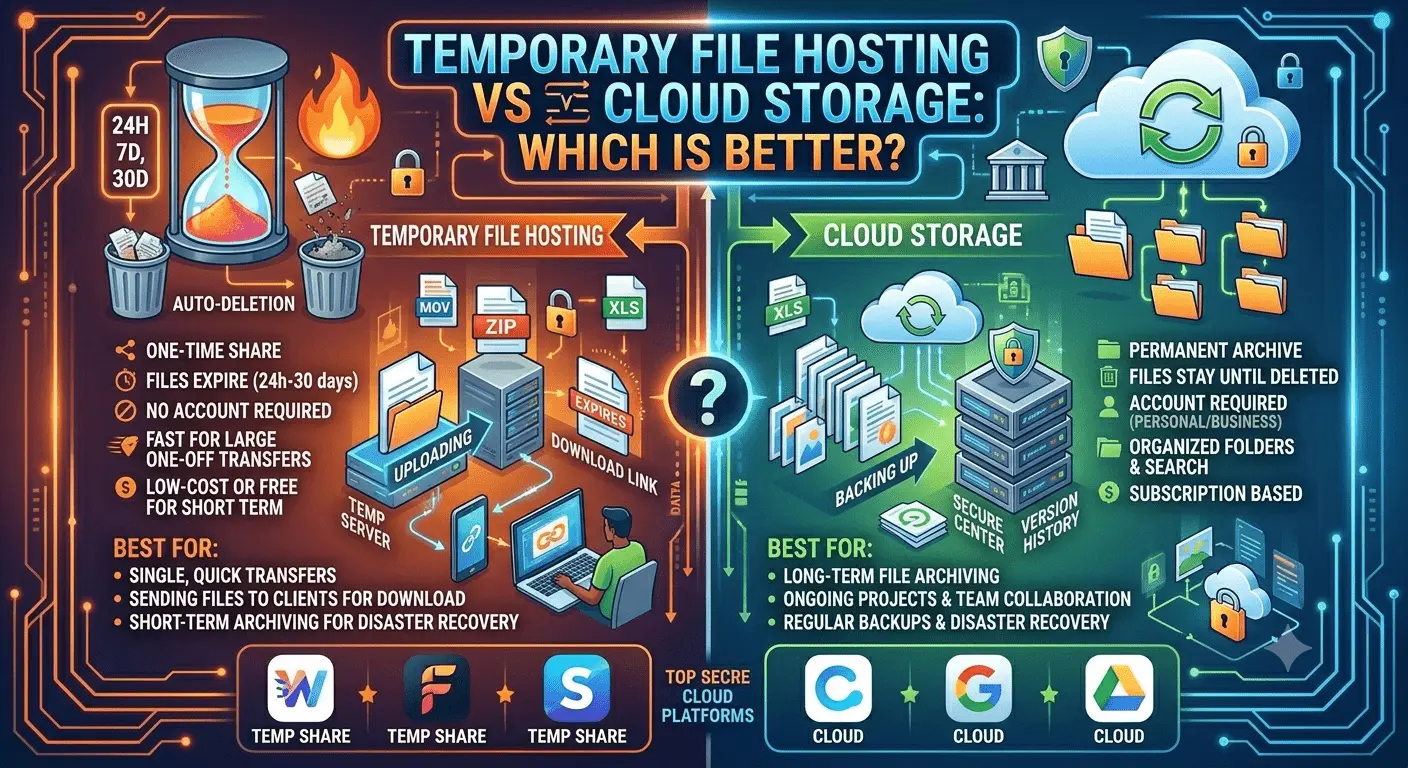
Temporary file hosting allows users to upload files for a limited period and share them through downloadable links. These services are commonly used when users need to quickly transfer files without creating permanent storage archives.
Files are typically deleted automatically after a specified time period, helping reduce storage overhead while supporting short-term sharing requirements.
Cloud storage provides long-term online storage where users can organize, access, synchronize, and manage files across multiple devices. Modern cloud platforms often include collaboration features, version history, access controls, and security tools.
Cloud storage services are designed for ongoing file management rather than temporary transfers. Platforms such as MediaFire allow users to store, organize, access, and share files across devices while maintaining cloud-based accessibility.
Temporary file hosting is ideal when users need to share files quickly without maintaining permanent online storage.
For many users, temporary hosting provides a simple and efficient method for transferring data without creating permanent storage footprints.
Cloud storage becomes the preferred solution when files must remain accessible for extended periods.
Many organizations rely on cloud storage to centralize information and streamline digital workflows.
Security should be a priority regardless of which solution you choose. Features such as encrypted transfers, password-protected links, permission controls, and secure storage environments help reduce risks associated with online file sharing.
Cloud storage providers often offer additional management and access-control tools, while temporary hosting services frequently emphasize automatic deletion and reduced retention periods as privacy benefits.
Temporary file hosting services often provide straightforward pricing focused on transfer capacity and file retention periods. Cloud storage services typically charge based on storage space, collaboration features, and business requirements.
The most cost-effective option depends on how frequently files are transferred and how long they need to remain available.
Temporary hosting platforms generally prioritize simplicity and speed. Users upload files, generate a link, and share it immediately.
Cloud storage platforms provide more comprehensive file management features, making them ideal for ongoing workflows and long-term organization.
According to the MediaFire Overview, cloud storage services allow users to store, organize, access, and share files through web and mobile platforms. Features such as folder management, file sharing links, and multi-device access demonstrate how cloud storage supports long-term file management and collaboration.
If your goal is fast, short-term sharing with minimal management requirements, temporary file hosting may be the best option.
If you require long-term organization, collaboration, backups, and multi-device access, secure cloud storage solutions often provide greater flexibility and scalability.
Many users ultimately benefit from using both approaches depending on the situation and project requirements.
As digital collaboration continues to expand, both temporary hosting and cloud storage will remain important tools. Temporary hosting will continue serving quick-transfer needs, while cloud storage platforms will evolve with stronger security, improved collaboration features, and more advanced file management capabilities.
Neither temporary file hosting nor cloud storage is universally better. The ideal choice depends on how you manage, share, and retain files. Temporary hosting excels at quick, privacy-focused transfers, while cloud storage offers long-term organization and collaboration benefits.
By understanding the strengths of each solution, users can select the approach that best supports their workflow, security requirements, and storage goals.