Get Marketing Insights First
Subscribe to receive actionable strategies, growth tips, and industry insights delivered straight to your inbox.


Cloud storage and file sharing technologies have transformed the way individuals and businesses manage information. What began as a convenient way to store files online has evolved into a critical component of digital transformation, enabling remote work, real-time collaboration, cybersecurity protection, and global business operations.
As organizations generate more data and rely increasingly on cloud-based workflows, the next generation of cloud storage solutions is expected to become smarter, faster, more secure, and more integrated with emerging technologies such as artificial intelligence, edge computing, and automation. Industry analysts continue to project strong growth for the cloud storage market as organizations accelerate digital transformation initiatives.
Cloud storage has moved far beyond simple online file repositories. Modern platforms provide collaboration tools, version control, secure sharing, workflow automation, synchronization across devices, and advanced access management.
According to Dropbox, cloud computing allows users and organizations to store, manage, and access data through internet-based infrastructure rather than relying solely on local hardware.
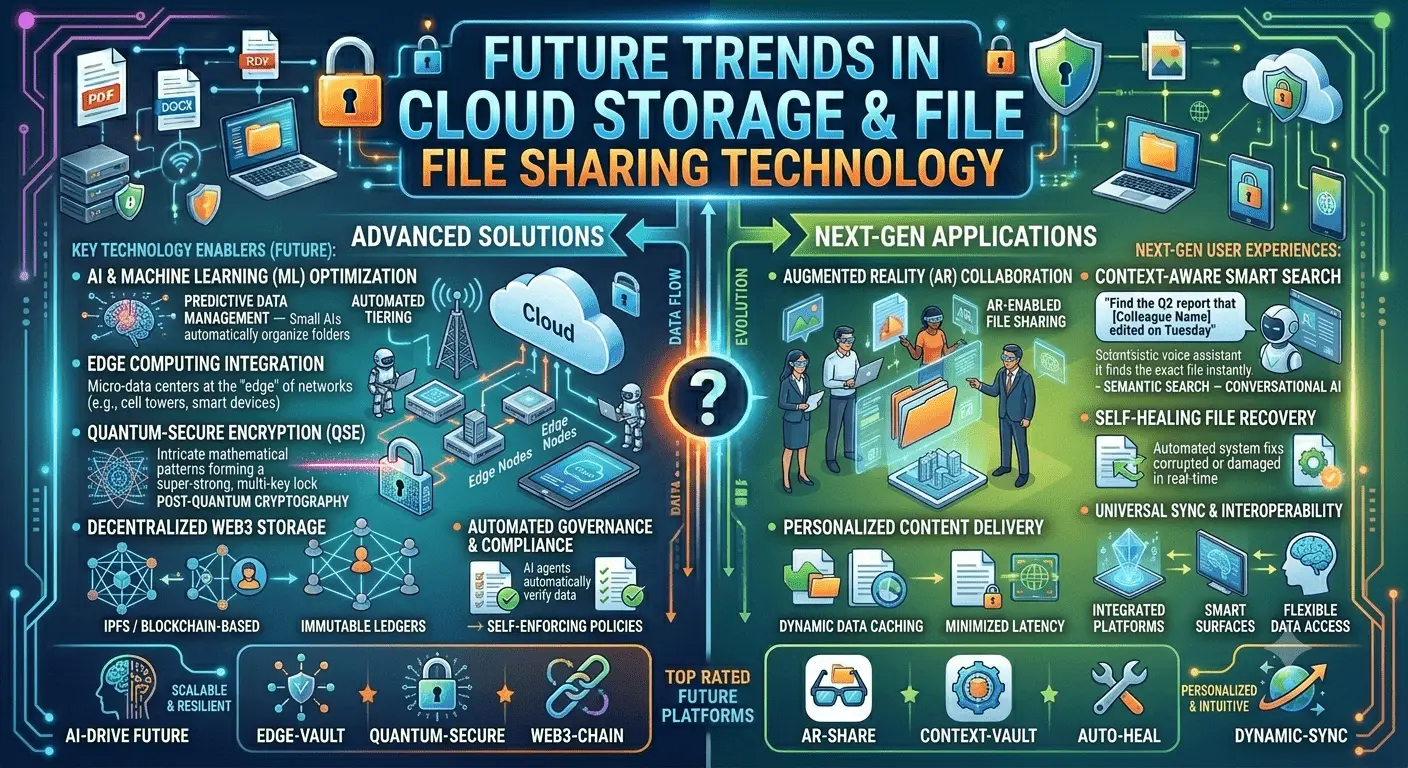
Artificial intelligence is expected to become one of the most influential forces shaping the future of cloud storage. AI-powered systems can automatically organize files, classify content, improve search capabilities, identify duplicate data, and provide intelligent recommendations.
Recent industry developments show cloud providers increasingly integrating AI-driven search, file summarization, automated categorization, and contextual insights directly into storage platforms.
Traditional folder structures are gradually being supplemented by intelligent search systems capable of understanding natural language queries. Users will spend less time browsing directories and more time accessing the exact content they need.
AI-assisted search technologies are expected to become standard features across leading cloud storage platforms.
Cybersecurity remains a major priority for organizations storing sensitive information in the cloud. Future cloud storage solutions will increasingly adopt zero-trust security models, continuous authentication, advanced encryption, and automated threat detection.
Growing concerns about data protection, compliance, and cyber threats are driving organizations to prioritize stronger cloud security frameworks.
Businesses are moving away from relying on a single cloud provider. Instead, many organizations are adopting hybrid and multi-cloud strategies that combine public cloud services, private infrastructure, and specialized cloud environments.
This approach provides greater flexibility, improved resilience, better compliance management, and reduced vendor lock-in. Industry experts increasingly describe future cloud infrastructure as “hybrid-by-design.”
Edge computing brings processing and storage resources closer to users and devices. Instead of transferring all data to centralized data centers, edge infrastructure reduces latency and improves performance.
This trend is expected to support real-time collaboration, IoT applications, video processing, and data-intensive workloads that require faster response times.
Governments and businesses are placing greater emphasis on where data is stored, processed, and governed. Regulatory requirements and privacy concerns are driving demand for sovereign cloud solutions.
Organizations increasingly seek greater control over data location, governance, and compliance obligations.
Future file-sharing platforms will continue integrating communication, project management, workflow automation, document editing, and AI-powered collaboration tools directly into cloud environments.
Businesses increasingly prefer unified digital workspaces that reduce the need for multiple disconnected applications.
Machine learning and automation technologies will help organizations manage growing volumes of data more efficiently. Automated retention policies, lifecycle management, intelligent archiving, and predictive storage optimization will become increasingly common.
Researchers continue exploring AI-driven autonomous resource management to improve efficiency and scalability across cloud environments.
Software-as-a-Service (SaaS) ecosystems are expected to play an even larger role in cloud storage adoption. Organizations increasingly favor subscription-based platforms that provide integrated storage, collaboration, security, analytics, and workflow management.
The rapid growth of cloud services continues to fuel innovation across SaaS-based storage and collaboration platforms.
The demand for scalable storage, remote collaboration, data protection, and digital transformation initiatives continues driving significant market expansion. Analysts project strong long-term growth in cloud storage adoption across virtually every industry.
The Dropbox Official Site demonstrates how cloud storage providers are evolving beyond simple file storage by integrating AI-powered search, collaboration tools, intelligent workflows, and advanced file management capabilities. Recent product developments highlight the growing role of AI in improving productivity and information discovery.
Businesses looking to stay competitive should monitor the future of cloud storage and emerging technologies that influence how data is stored, managed, and shared.
Modern platforms such as next generation file sharing solutions are increasingly focused on security, automation, collaboration, and user experience.
Organizations that adopt these innovations early will be better positioned to improve efficiency, strengthen security, and support long-term digital transformation goals.
The future of cloud storage and file sharing technology will be defined by artificial intelligence, stronger cybersecurity, hybrid cloud architectures, edge computing, and smarter collaboration tools. As digital transformation accelerates, organizations will increasingly depend on cloud platforms that offer flexibility, automation, and secure access to information.
Businesses and individuals who understand these trends today will be better prepared to take advantage of the next generation of cloud innovation tomorrow.